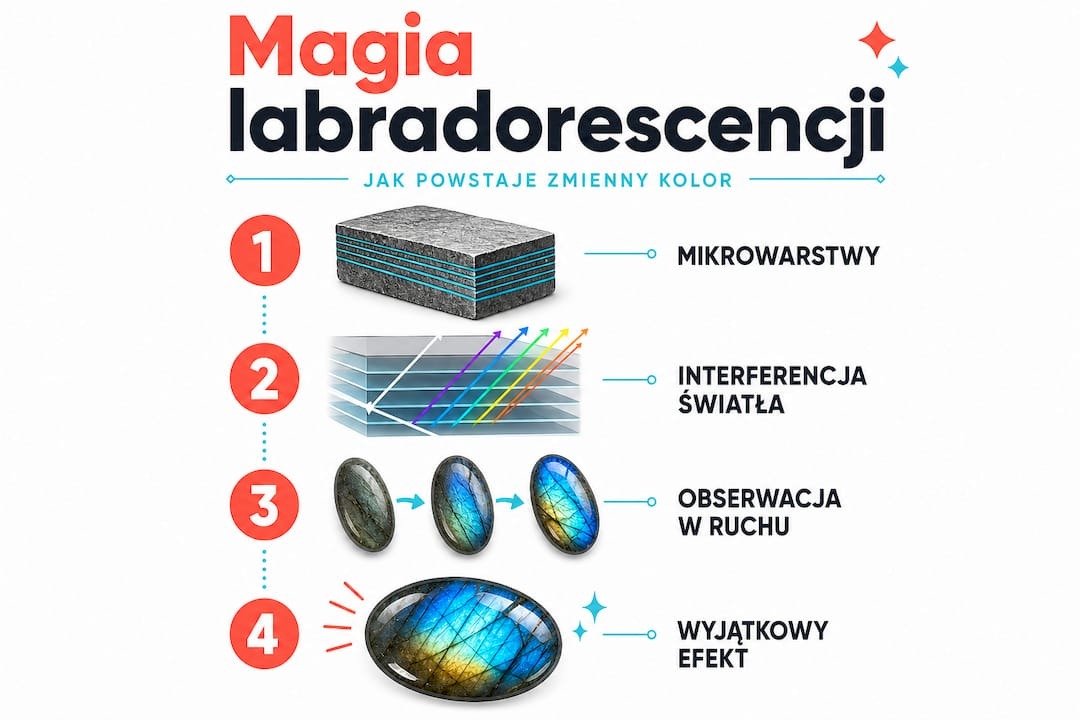
How light and cut affect labradorite jewelry
Now that you know the mechanism, it is worth learning how to get the most out of labradorite in practice, because not every stone and not every cut gives an equally dazzling result.
The quality of labradorite in jewelry depends on several factors. The most important is the so-called “effect window” — the area of the stone where labradorescence is visible and intense, depending on the light. In top-grade stones the window covers almost the entire surface. In cheaper specimens the effect may appear in only one corner or be very faint.
The cabochon cut (rounded, without facets) is the classic choice for labradorite. Why? Because the domed surface lets the stone “gather” light from several directions at once, so the color effect is visible across a wide range of angles. A dome-shaped stone works like a focusing lens, intensifying the play of color.
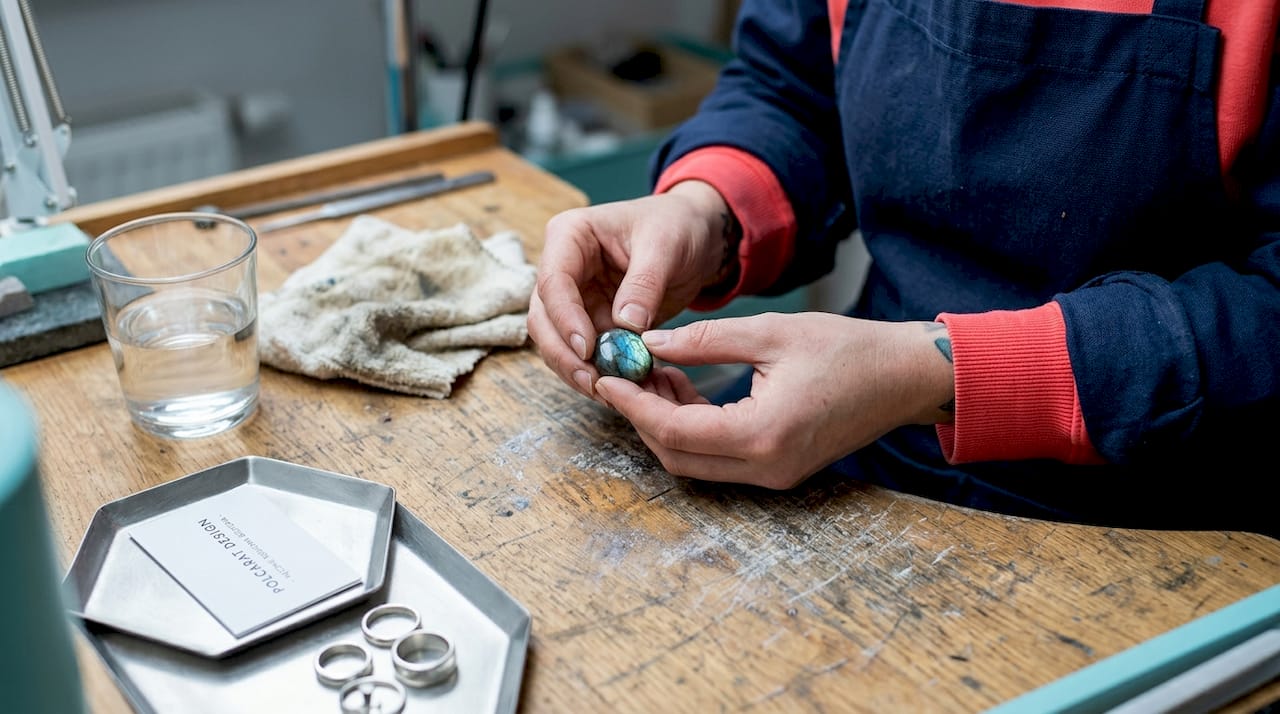
The faceted cut (with many flat faces) gives a different impression. Each facet reflects light at a different angle, creating a mosaic effect. Faceted labradorite can look like a miniature rainbow cut into pieces. It is a less classic but very modern and striking approach.
Cabochon vs faceted labradorite: each cut changes the way the stone plays in the light.
| Feature | Cabochon | Faceted cut |
|---|
| Visibility of labradorescence | Wide viewing angle, full play of color | Pinpoint, dramatic flashes |
| Jewelry style | Classic, romantic | Modern, avant-garde |
| Color intensity | Soft, diffused | Strong, intense |
| Cutting cost | Lower | Higher |
| Recommended for | Pendants, rings | Earrings, brooches and necklaces |
How do you choose good labradorite jewelry? Here are the steps worth taking before you buy:
- Ask the seller to show you the stone from different angles and under several types of lighting
- Check that the labradorescence covers most of the stone’s surface, not just a fragment
- Judge the color intensity: genuine high-quality labradorite does not need a strong spotlight to come alive
- Look at the setting: silver contrasts with the stone’s dark tones and brings out the depth of its colors
- Make sure the stone is natural, not dyed or synthetic
Pro tip: if you can, look at the jewelry in natural light before you buy. Many shops use strong spotlights that can exaggerate the effect even in a weak stone. Daylight is an honest test of labradorite quality.
Labradorite looks its best in motion and when the cut matches the stone’s effect window. That is why it pays to choose jewelry in which the stone can catch light from every side. A labradorite pendant swaying at your neck as you walk is a real show, because every step changes the angle of the light and reveals another color. A labradorite bracelet works the same way, coming alive on your wrist with every gesture of your hand.
Movement is the key to everything. Labradorite jewelry is not meant to sit still in a display case. It is made to be worn, to be part of your life and to keep surprising you with new shades.
Why we fall for labradorite: magic rooted in science
So where does such fascination with one particular stone come from — a stone people return to again and again?
Labradorite is a stone you cannot fully describe or photograph, because its optical properties change with the angle of the light. And that is precisely its greatest strength. Every photo is just a single frame from a long, beautiful film. A real encounter with labradorite happens only in person, when you hold it in your hand and watch it change before your eyes.
What makes labradorite so desirable is a combination of several distinctive traits:
- No repetition: no two stones look the same, because each has its own arrangement of mineral layers
- Change over time: the same stone looks different in the morning and in the evening, in sunshine and under clouds
- Surprise: colors appear unexpectedly, bringing a genuine joy of discovery
- An emotional bond: the owner gets to know her stone gradually, discovering new shades day by day
- Originality: wearing labradorite means no one else has exactly the same piece, and its shifting colors always draw the eye
An Inuit legend says that labradorite is a piece of the northern lights locked in stone by the ancestors so that people could carry it with them. The aurora is one of nature’s most moving spectacles, and labradorite offers a small taste of it every day, on your wrist or at your ear.
It is also worth mentioning a trap many jewelry lovers fall into. “Photo” expectations can lead to disappointment, because labradorite looks best in motion and as the angle changes. A product photo in an online store shows the stone at one moment, from one angle, in one light. It is like judging a dancer by a single rehearsal photo. Labradorite’s real talent shows only in motion.
That is why labradorite builds such a strong emotional bond with the person who wears it. It is a stone that rewards attention and curiosity: the more time you spend with it, the more you discover. That is a rare trait in the world of jewelry, where most stones look much the same in any conditions. Interest in jewelry with natural stones keeps growing, because people want more than a pretty accessory. They want stones that mean something and tell a story.
Labradorite stands for originality not because it is fashionable, but because it is physically impossible for two people to own the same stone. Nature itself made sure that every specimen is different.
Labradorite properties: why trust science, not just legends
Let’s take a moment to reflect on what really draws us to labradorite: magic or science?
Over the years we have noticed a pattern in conversations about jewelry with natural stones, and labradorite in particular. When a customer learns that its stunning colors come from optical physics rather than mystical energy, she may lose a little enthusiasm for a moment — as if a scientific explanation could take something beautiful away. In fact, the opposite is true.
Science does not take the magic away. It gives it a foundation.
Once you understand that these incredible colors are created by nanometer-thin mineral layers formed over millions of years of geological processes, the stone stops being just a pretty stone. It becomes a record of Earth’s history captured in an object you carry with you — a story of igneous rock and deep time, from an age when the continents had different shapes. Labradorite formed when life on Earth looked completely different from today.
People who love authenticity and natural stones often have a deeper relationship with their jewelry than those who treat it purely as decoration. That relationship becomes richer still when it is backed by real knowledge about the stone. You can talk about your ring or earrings in a way that holds anyone’s attention. You can say, “Did you know the colors in this stone come from layers about as thin as a wavelength of light?” and watch genuine surprise appear on the other person’s face.
Our experience in helping customers choose jewelry tells us one more thing: people who understand a stone are less often disappointed with their purchase. They know what to look for, can judge quality and are not swayed by an attractive photo alone. And when their labradorite flashes by a café window at sunny noon, they know exactly why it happens and can fully enjoy the moment.
Emotion and science do not have to be at odds. They can coexist and enrich each other, and labradorite is the best proof of that. If you are interested in similar optical effects in jewelry, take a look at jewelry with opalescent crystals, which offers an equally fascinating play of light, though in a completely different way.
Give yourself permission to be amazed, both emotionally and intellectually. That combination turns jewelry from a mere accessory into part of your personality and the way you see the world.
Where to find beautiful labradorite jewelry
Now that you know what makes labradorite so special, it is worth knowing where to find jewelry that shows off its full beauty. At polcaratdesign.pl you will find carefully selected sterling silver jewelry with natural stones, including high-quality labradorite. Each design is created so that the stone can show its full color potential. Take a look at our labradorite earrings or a delicate labradorite bracelet, which move beautifully with every gesture and delight with their natural play of color. Natural stones and 925 sterling silver, cast and hand-finished in our family workshop in Rumia, Poland, come together in jewelry that will stay with you for years.
Labradorite FAQ: frequently asked questions
Why doesn’t labradorite always look colorful in photos?
Labradorite’s color effect appears mainly in motion and depends on the viewing angle, so photos often fail to capture the stone’s full charm. In practice, labradorite looks best when it moves, and every photo is just one of many possible frames.
Is labradorite a magical stone?
Labradorite has inspired legends and has a rich spiritual history, but its shifting colors are an optical phenomenon, not magic. Interference in the microscopic structure of the mineral is responsible for all those stunning colors, which makes this “aurora stone” a wonder of nature rather than of mysticism.
What should I look for when choosing labradorite jewelry?
Pay attention to the intensity and size of the area where the color appears, as well as the quality of the cut and setting. A good cut matched to the stone’s effect window decides whether it will show a full play of color or disappoint you with a faint sheen.
How is labradorescence different from opal’s play-of-color?
Labradorescence results from the interference of light waves in alternating layers within the mineral, while the play-of-color typical of opal comes from the diffraction of light. In labradorite, interference in microscopic structures means the colors are visible only at certain angles, whereas in opal the play of color can be seen from almost any side.