In short: if you’re wondering how to mix and match jewelry without a set, follow the common-denominator rule — your earrings and pendant should share at least one feature: the finish of the setting, the stone color, the shape or the character. One piece leads, the other plays a supporting role. You can wear silver and gold together as long as one metal clearly dominates and the other is just an accent.
Earrings from one series, a pendant from another, and a chain bought years ago — that’s what most jewelry boxes look like. A matching set guarantees that everything goes together, but it isn’t the only route to an elegant look. Below we show how to mix and match jewelry from different series so the result looks deliberate: what needs to repeat, how to coordinate setting colors, how to choose scale and length — and finally, five ready-made pairings and a quick checklist.
How to mix and match jewelry from different series — the common-denominator rule
For years a jewelry set was a byword for elegance: every piece with the same stone, in an identical setting. Today it’s just one option, and you can wear jewelry from different collections without losing any class. A clear trend of recent seasons is deliberate mixing — studs from one series, a pendant from another — and no one expects them to be twins. There’s one condition: there has to be a visible thread connecting the pieces.
The eye looks for order. If two pieces have nothing in common, the look seems random, as if one of them ended up in the outfit by mistake. But a single repeated feature is enough to make the same pair look planned. So instead of asking “Is this from the same set?” ask “What ties these two pieces together?”
Mixing Without Chaos
How to Mix and Match Jewelry — 5 Rules
Common denominatorA shared metal, color or stone
FinishOxidized with oxidizedor a deliberate contrast
ScaleBig earrings + a delicate pendantone piece takes the lead
ColorStones from one palettee.g. pink and purple
StyleBoho with boho, classic with classic
Four features that need to match
You don’t have to watch all of them at once — two shared points are usually enough, and one is the minimum.
- Setting finish — an oxidized (darkened) setting looks completely different from a high-polish or rhodium-plated one. When both pieces have a similar finish, they can differ in stone and shape and still make a pair.
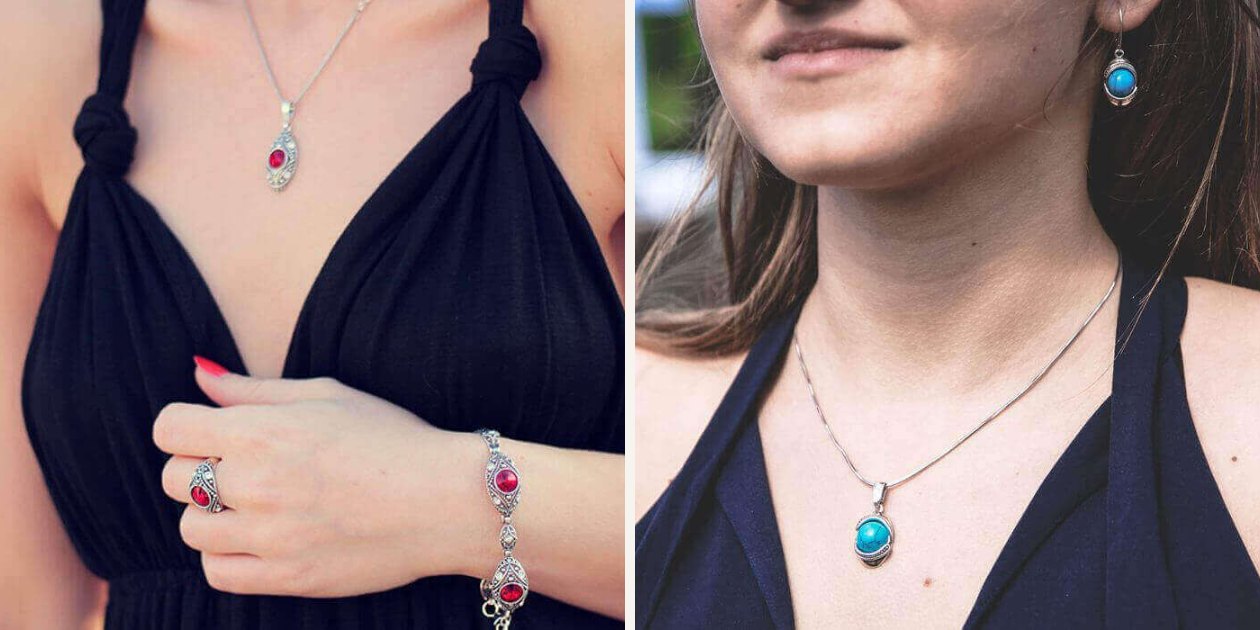
- Color or stone — the same stone in both pieces is the simplest solution. A shared shade works too: the green of reconstructed malachite and green agate, the blue of labradorite and sodalite, the pink of rose quartz and pearly white. Different colors also work if they come from one palette — warm or cool.
- Scale and proportions — one piece is bold, the other subtle. Big drop earrings and a big pendant start competing, while small studs with a statement pendant create a clear hierarchy.
- Character — a minimalist geometric pendant won’t always get along with openwork, ornamental retro-style designs. Stick to one mood: classic, romantic, boho or modern simplicity. It’s this consistency of jewelry style that keeps a mix from jarring.
A simple test: lay the earring and the pendant side by side in your palm. If your eye jumps between them with nothing to hold on to, swap one of them for a piece that repeats the color, shape or finish of the other.
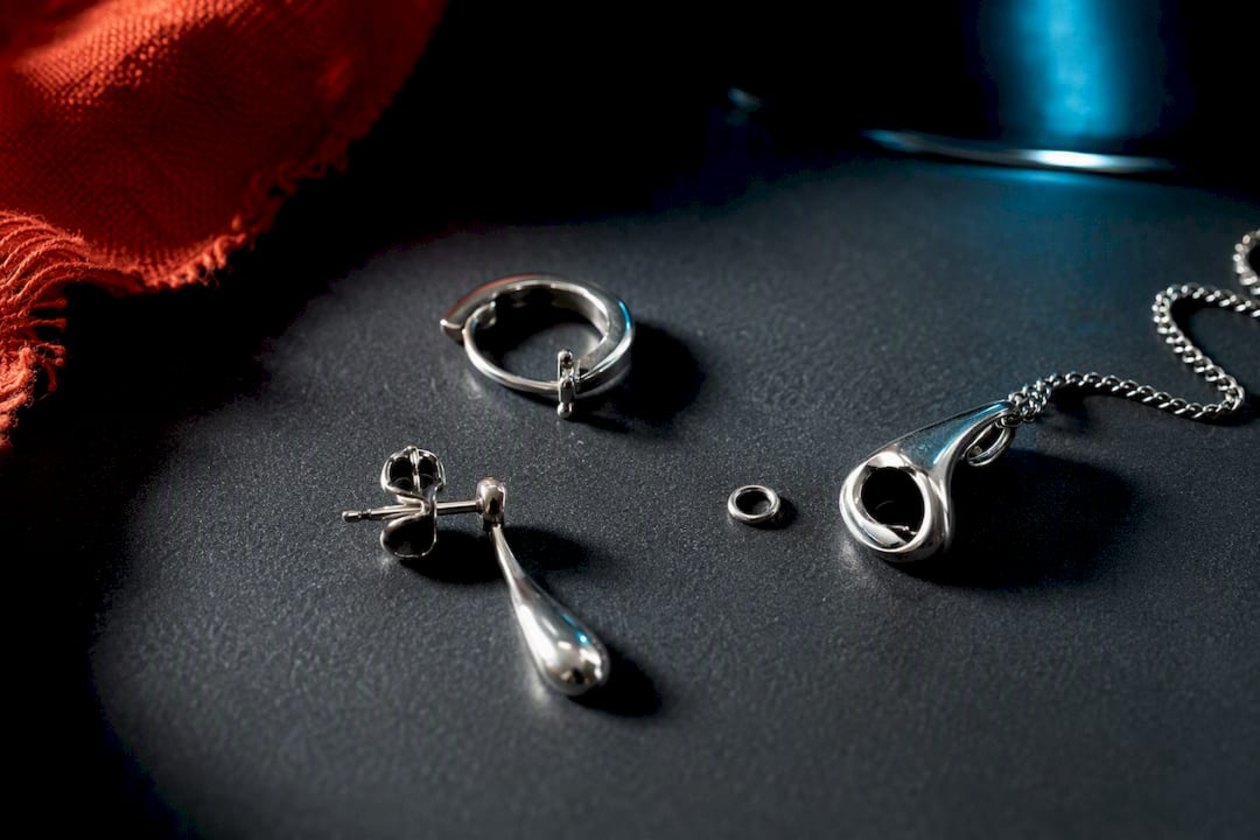
Combining gold and silver in one look
For years the rule was one setting color. Today gold and silver jewelry in the same jewelry box is the norm, and you can confidently combine gold and silver without fear of a fashion faux pas — as long as you do it with a plan. You don’t have to limit yourself to one metal, but one color should clearly dominate and the other should appear as an accent. When the proportions are equal, the eye can’t tell which piece is the main one.
The simplest way to combine gold with silver is to divide by zones: gold earrings near the face and a pendant in a pale setting at the neckline — or the other way around. A piece that features both colors also helps: a two-tone ring, a watch with a two-tone bracelet or a gold-plated pendant on a silver chain. A yellow gold wedding band doesn’t rule out pieces in a pale setting — it’s enough for the warm color to appear in them at least once, for example in a gold-plated detail or in amber.
Warm or cool palette?
Gold colors differ more than you might think. Classic yellow gold is warm and intense, rose gold has a soft, slightly coppery tone, and white gold is cool and from a distance resembles a rhodium-plated setting. The warm glow of gold usually looks better with warm skin tones (golden, peachy), and the cool brightness of rhodium with fair, pinkish skin. That’s a guideline, not a rule: your coloring suggests a direction, but in the end what matters is what you feel most like yourself in.
Oxidized, polished and gold-plated
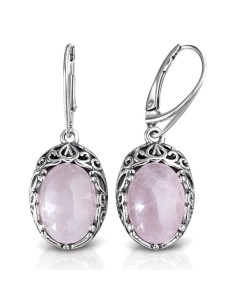
Mixing doesn’t have to be about colors alone. A pairing of finishes is just as interesting: an oxidized setting emphasizes the ornament and gives jewelry a vintage feel, while a polished one offers a clean, bright shine. Openwork oxidized studs and a smooth, shiny pendant create a contrast that adds depth to the whole look. Gold-plated silver, in turn, acts as a bridge — it goes with a pale setting as well as with the gold jewelry you already own. We describe the differences between finishes in our article rhodium plating, oxidizing or gold plating — which finish to choose, and our comparison of precious metals and surgical steel will help if you’re just starting to build your jewelry collection.
Scale, shape and chain length
Earrings and a pendant are seen together, in one frame with your face and neckline, so hierarchy matters — one piece takes the lead.
- Small studs and a statement pendant — attention shifts to the neckline. A great choice for work and with loose hair, which covers your ears anyway.
- Long drop earrings and a subtle pendant — your face is the focus, and the neckline gets just a delicate sparkle. Works well with hair worn up and in the evening.
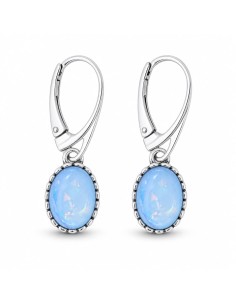
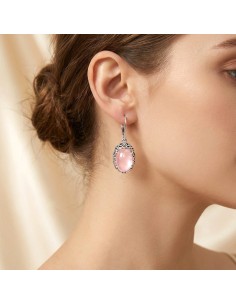
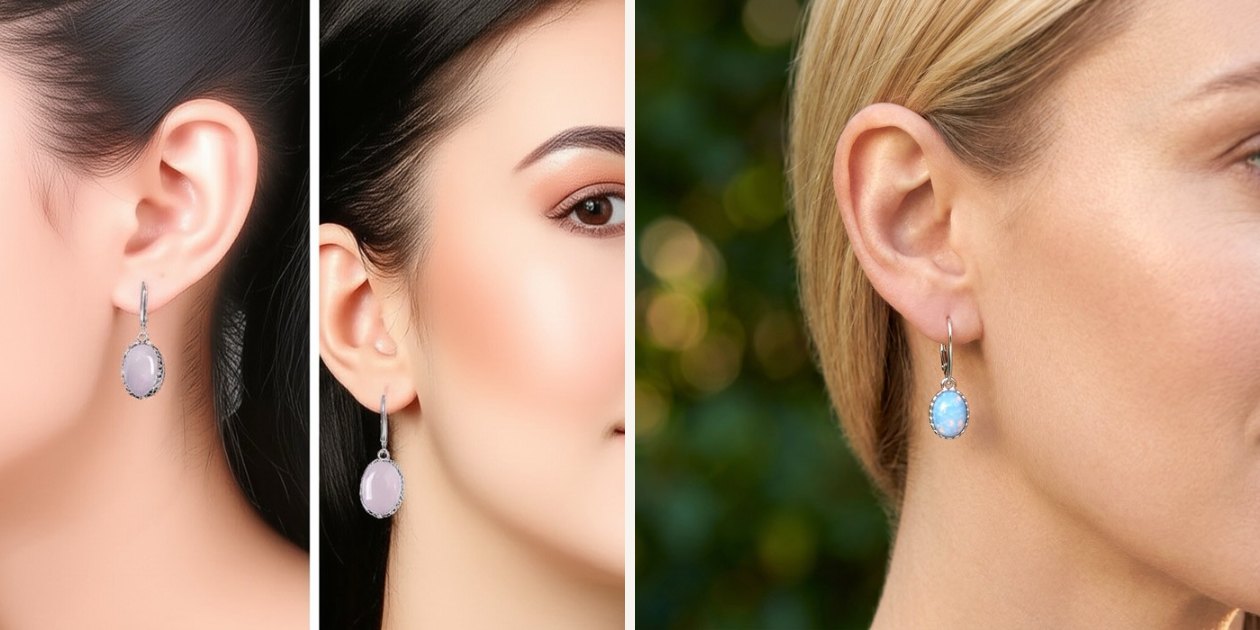
- A repeated shape — an oval in the earrings and an oval cabochon in the pendant, a circle and a sphere, a teardrop and a teardrop. Shape can tie pieces together even when the stones differ.
Match the chain length to your neckline: a shorter one, about 40–45 cm (16–18 in), ends around the collarbones and looks nice with a higher, round neckline, while a longer one, about 50–60 cm (20–24 in), falls lower and suits a V-neck. You’ll find more examples in our guide on how to match a necklace to your neckline. If you like layering necklaces of different lengths, leave a few centimeters (an inch or two) between them so they don’t merge into one line. Layers follow the one-focal-point rule: one larger pendant, and the rest are thin chains.








Comments (0)