In short: a cabochon is a stone cut into a smooth, rounded dome — no facets and no sharp edges, usually with a flat back. It doesn’t split light the way facets do; instead, it brings out color, pattern and optical effects such as cat’s eye or opalescence. This cut is used mainly for opaque and translucent minerals, and in silver jewelry cabochons are held in a metal bezel that wraps around the dome.
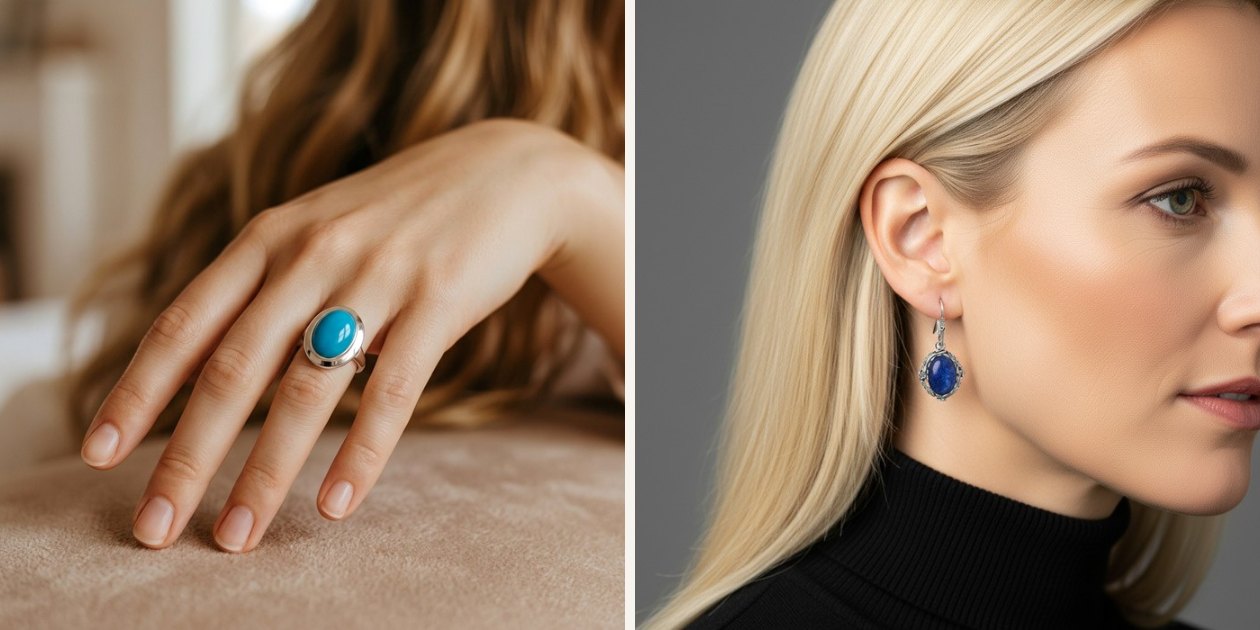
A smooth oval of turquoise in a grandmother’s brooch, green malachite in a pair of earrings, honey-colored amber in a pendant — what they share is the cabochon cut. So what is a cabochon? Below we explain where the name comes from, what types of cabochons there are and how they’re set in silver, and finally how to choose and wear this kind of jewelry.
What is a cabochon, and where does the name come from?
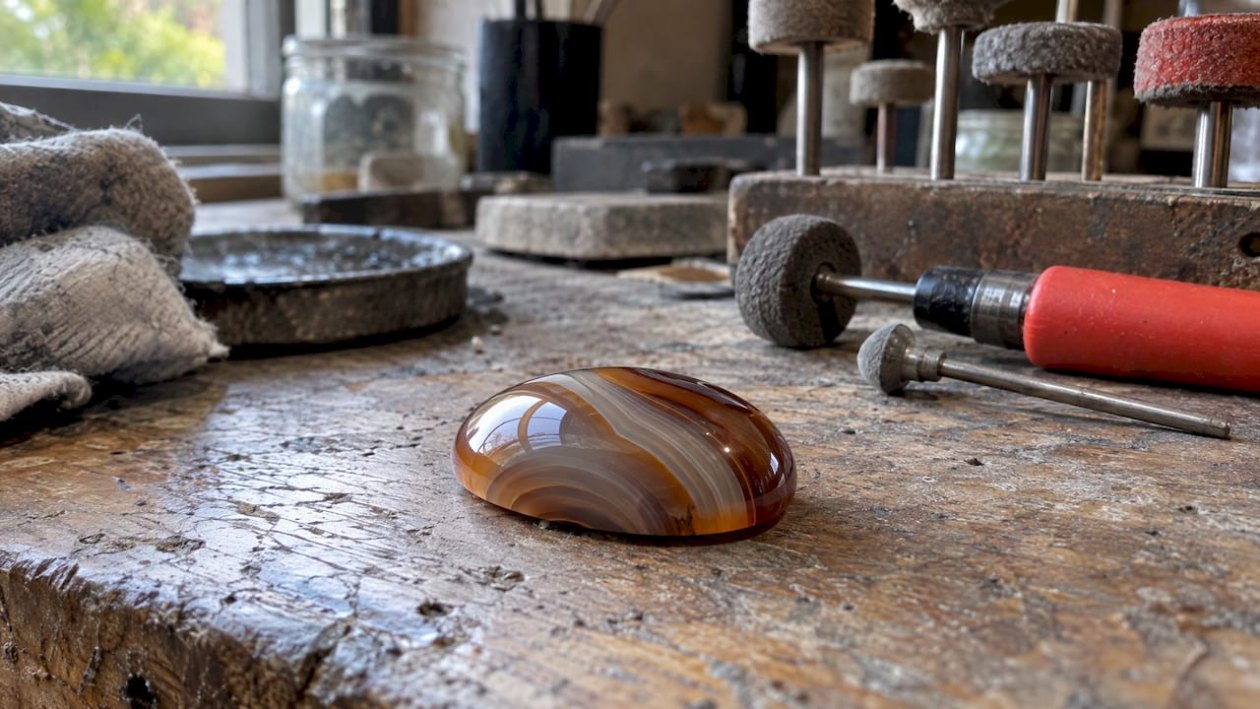
It’s a way of working a stone so that it gets a smooth, polished, dome-shaped surface. A finished cabochon has no facets or edges, so you look into it as if through a window — straight into the depth of its color. The back is usually flat, so it sits securely in a metal setting. Jewelers also call this a smooth or unfaceted cut.
The name comes from French: cabochon derives from caboche, a colloquial word for “head,” so it literally means “little head” — and it does look like the rounded head of a nail. In the jewelry trade the word is often shortened to “cab.” In art history the same term also describes a decorative motif: an oval boss in ornamentation that imitates a polished stone.
It’s one of the oldest techniques in jewelry making. Before craftsmen learned to cut precise facets, stones were simply smoothed and polished. That’s why cabochons adorn medieval crowns, reliquaries and book covers.
Cabochon vs faceted stone — the key differences
The easiest way to understand the difference is to compare the two cuts side by side. Facets work like tiny mirrors: they split the light, so the stone sparkles with every movement. A smooth dome reflects light softly, in a single bright highlight, and draws attention to color and pattern — you can see the natural beauty of its hues, bands and veins.
| Feature | Cabochon | Faceted cut |
|---|
| Surface | smooth, rounded dome | many flat, symmetrical facets |
| Edges | no sharp edges, soft outline | distinct edges between facets |
| Typical minerals | opaque and translucent | mostly transparent |
| What it highlights | color, banding, optical effects | brilliance and sparkle |
| Character | calm, classic | glittering, evening |
| In wear | smooth to the touch, less prone to chipping | corners need protection |
Neither is “better” — they’re two different languages: a faceted sapphire sparkles, while a sapphire cabochon takes on a velvety depth.
Types of cabochons — profile, shape and size
Cabochons differ in profile, outline and size.
Profile, or the side view
- Single — a domed top and a flat back; the most common form, because the flat base sits securely in the bezel.
- Double — rounded on the underside as well; sometimes set in openwork mounts that show it from both sides.
- High — strongly domed; it shows the cat’s eye band and other light effects best.
- Low — almost flat; good for minerals with a distinct pattern, such as banding.
- Hollow — with a slightly concave back that lightens dark, highly saturated minerals such as garnets.
Shape and size
Seen from above, a cabochon is usually oval or round — a regular outline guides light evenly across the dome and is easy to fit to a setting. You’ll also find teardrops, marquises, rectangles with rounded corners, hearts and free-form shapes, cut so that the most beautiful part of the pattern lands in the center. So the shape of a cabochon is chosen not only for the design but also for the stone’s pattern. Size is usually given in millimeters — from tiny stones in earrings to large domes that take center stage in a ring or pendant.
Which stones are cut as cabochons?
A smooth dome is chosen when a mineral has something to show beneath the surface: color, pattern or a play of light. In opaque turquoise, facets would have nothing to split, while a smooth surface lets the color flow. The stones most often cut this way are:
- opaque minerals with intense color — turquoise, lapis lazuli, malachite, onyx, coral and jasper;
- minerals with a distinct pattern — banded agate, landscape jaspers, specimens with dendrites;
- milky and translucent materials — chalcedony, carnelian, rose quartz and, among organic materials, amber;
- minerals with optical effects — labradorite, cat’s eye chrysoberyl and star sapphires.
We write about the trend for these colors in our article on milky and opaque stones coming back into fashion.
Cat’s eye, stars and play of color — effects you can see in a cabochon
Some light effects appear only on a smooth surface — facets would make them disappear. The cat’s eye effect (chatoyancy) is a narrow, bright band that glides across the dome with every movement, like a cat’s narrowed pupil; it’s caused by parallel fibers or tiny channels inside the mineral. Asterism is several such bands arranged in a star — familiar from star sapphires. Opalescence is a milky, pearly glow scattered beneath the surface, and labradorescence means blue-green and golden flashes that appear at certain angles.
Multicolored flashes that change with every movement of the hand are known as play of color — the hallmark of opal, which shows it at its fullest on a smooth dome.
Profile and shape
Types of Cabochons — Cheat Sheet
Single cabochona domed top and a flat backthe most common in jewelry
Double cabochondomed on both sidesfor stones seen from both sides
High cabochona strongly domed topshows cat’s eye and asterism
Low cabochona gentle, almost flat domecomfortable for everyday wear
Hollow cabochona slightly hollowed-out backlightens dark stones
Shapesoval, round, teardrop, rectanglethe oval is a classic in silver
Cabochons made of stone, glass or resin?
The cut itself says nothing about where the material comes from. There are four groups:
- Natural — natural stones are minerals and organic materials (such as amber or coral) formed in nature; they are sometimes dyed, which an honest seller notes in the description.
- Reconstructed — made from natural mineral particles that are pressed and bound together; some turquoise and malachite, for example, is produced this way.
- Synthetic — they have the composition and structure of their natural counterpart but were created in a laboratory.
- Imitations — they only mimic the look, for example glass or plastic.
These groups are hard to tell apart by eye, which is why accurate information matters. At Polcarat Design we state the type of stone in every product description. You can read more about these terms in our guide to natural, synthetic and reconstructed stones and what each word means.
The trade still talks about precious and semi-precious stones, although gemologists avoid the term “semi-precious” and distinguish instead between gemstones and ornamental stones. Cabochon is the name of a form, not a species, so both groups are cut this way.
Glass cabochons and other craft supplies
If you search for “cabochon” in a craft supply store, you’ll mostly find glass cabochons, resin cabochons, ceramic cabochons and even wooden ones. Picture cabochons are popular too — a glass lens with an image glued underneath, which crafters often buy in matching pairs. These are components for DIY jewelry: they’re glued into ready-made bases for rings, brooches and hair clips, framed with bead embroidery or soutache braid, or wrapped in wire. Resin work also produces resin cabochons with embedded dried flowers, and mineral shops often sell druzy pieces and dyed howlite posing as turquoise. They’re inexpensive and easy to use, but most of them are imitations. In fine jewelry, the stone is set in metal.




Comments (0)