In short: Mother of pearl (also called nacre) is the inner layer of the shells of certain mollusks, including pearl oysters and abalone. It is made of thin platelets of aragonite bound together by an organic substance called conchiolin, and light reflected from these layers creates a rainbow play of color known as iridescence. Pearls are made of the same substance — the difference lies in the form, not the material. Mother of pearl is soft and sensitive to cosmetics, so in jewelry it needs a good setting and gentle care.
A milky white with pink and greenish glints that shift with every movement of your hand — that is the signature of the material from inside a seashell. Mother of pearl has decorated objects for thousands of years, and it looks just as good in silver pendants, bracelets and earrings as it once did on antique jewelry boxes. Below we explain how mother of pearl forms, how it differs from a pearl, how to recognize an imitation and how to care for mother-of-pearl jewelry so it keeps its beauty for a long time.

What is mother of pearl?
It is a natural material of organic origin, not a mineral mined from the ground. Mollusks produce it to line the inside of their shells. The smooth, hard coating protects their soft bodies from irritation.
Not every species produces it. In crafts and jewelry you will most often come across material from three groups of animals:
- Pearl oysters — marine bivalves from warm waters. They yield white, cream, silvery or pinkish material, and in some species a dark one.
- Abalone — sea snails with a flat, ear-shaped shell. This group includes paua from New Zealand, known for its intense blue-green and purple colors.
- Nautiluses — cephalopods with a spiral shell whose interior is coated with the same lustrous layer.
The raw material often comes from shells left over from pearl farming or from fishing for food. The shells are cut into plates, from which cabochons, ovals or leaf shapes are cut out, then ground and polished.
Layered structure — where does the rainbow sheen come from?
Mother of pearl builds up gradually as the animal grows. It is produced by the mantle — the tissue lining the inside of the shell — which lays down one very thin layer after another. Each layer consists of microscopic platelets of aragonite, a crystalline form of calcium carbonate, bound with conchiolin, an organic substance. Under a microscope it looks like a brick wall: hard platelets with flexible “mortar” between them. That structure makes the material surprisingly resistant to cracking.
The platelets are close in thickness to the wavelengths of visible light. Light bounces off successive layers, and the reflected waves overlap — some colors are amplified, others cancel out. This is how iridescence arises: an opalescent, rainbow play of color that changes as you look at the surface from different angles. You can see a similar effect on a soap bubble.
At a glance
Mother of Pearl vs Pearl — Cheat Sheet
Mother of pearlthe inner layer of a shellplates, cabochons, inlays
Pearla nugget that grows inside a molluskround beads, teardrops
Structurearagonite and conchiolinthe same material in both
Hardnessapprox. 2.5–4.5 on the Mohs scaleprotect it from scratches
Carea soft cloth, no chemicalsput it on after perfume
The second important property is hardness. Mother of pearl rates roughly 2.5–4.5 on the Mohs scale — softer than glass and much softer than quartz. That makes it prone to scratches: fine grains of sand in household dust can leave marks on it. Its main component also reacts with acids, so lemon juice, vinegar, sweat, perfume and some cosmetics can dull the surface.
White, graphite or turquoise — natural and dyed colors
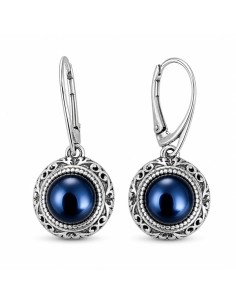
The color depends mainly on the species and on which part of the shell the plate was cut from. The most common shades are white, cream, silvery gray and a soft pink with greenish or bluish reflections. The lining of some shells is naturally dark — graphite or almost black, with peacock-like green and purple glints.
Many dyed plates are also on sale: turquoise, pink, red, black or blue. Dyeing doesn’t take away the play of light, but it changes the character: white and cream are subtle and timeless, while dyed colors work as a bold, summery accent. It is a long-established technique, not a fake — what matters is knowing what you are buying.
How to tell mother of pearl from an imitation
Imitations made of plastic, resin or glass can be convincing, but a few details usually give them away:
- Pattern — the natural material has irregular bands, streaks and smooth color transitions, while an imitation tends to be perfectly even or has a repeating pattern.
- Play of light — turn the piece in your fingers. The real material shifts in color and depth; a fake often has a flat sheen that looks printed on.
- Temperature — a genuine plate feels cool to the touch and warms up more slowly than plastic.
- Edge — if the edge is exposed, under a loupe you’ll see very thin layers stacked one on top of another.
From mosaics to jewelry — history and uses
Mother of pearl has a long history — ornaments made from shells, including their lustrous lining, are known from ancient Mesopotamia and Egypt. Over time, it found its way into many decorative crafts:
- Furniture and boxes — inlay made of small plates set into wood or lacquer created intricate patterns on tabletops, lids and frames.
- Buttons — just a few generations ago they were standard on elegant shirts and blouses.
- Instruments and small objects — fret markers on guitar necks, knife handles, opera-glass casings, fans.
- Jewelry — cabochons, plates, cameos, beads and charms set in silver and gold.
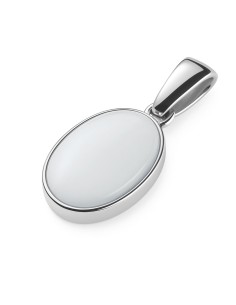
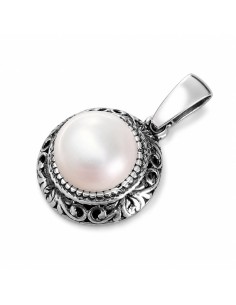
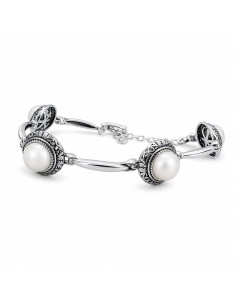
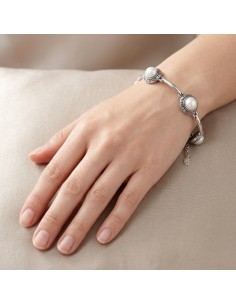
In jewelry, mother of pearl has one big advantage: it can be cut and shaped into almost any form. It can become an oval for a ring, a teardrop for a pendant or a flat leaf. Large, flat surfaces show off its sheen best, which is why jewelers like to set it in wide bezels on pendants and bracelets. It also pairs beautifully with oxidized silver: against the darkened background, the pale plate practically glows. We describe the differences between finishes in our article rhodium-plated, oxidized or gold-plated silver.
Mother of pearl in Polcarat Design silver
In our family workshop in Rumia, Poland, we have worked with 925 sterling silver since 1984, and our alloy contains no nickel. Our designs are cast and then hand-finished: we set the stones, solder, join bracelet links, grind and polish. With such a delicate material the setting matters especially, because a well-made silver frame protects the edges of the plate, which are the easiest part to chip.
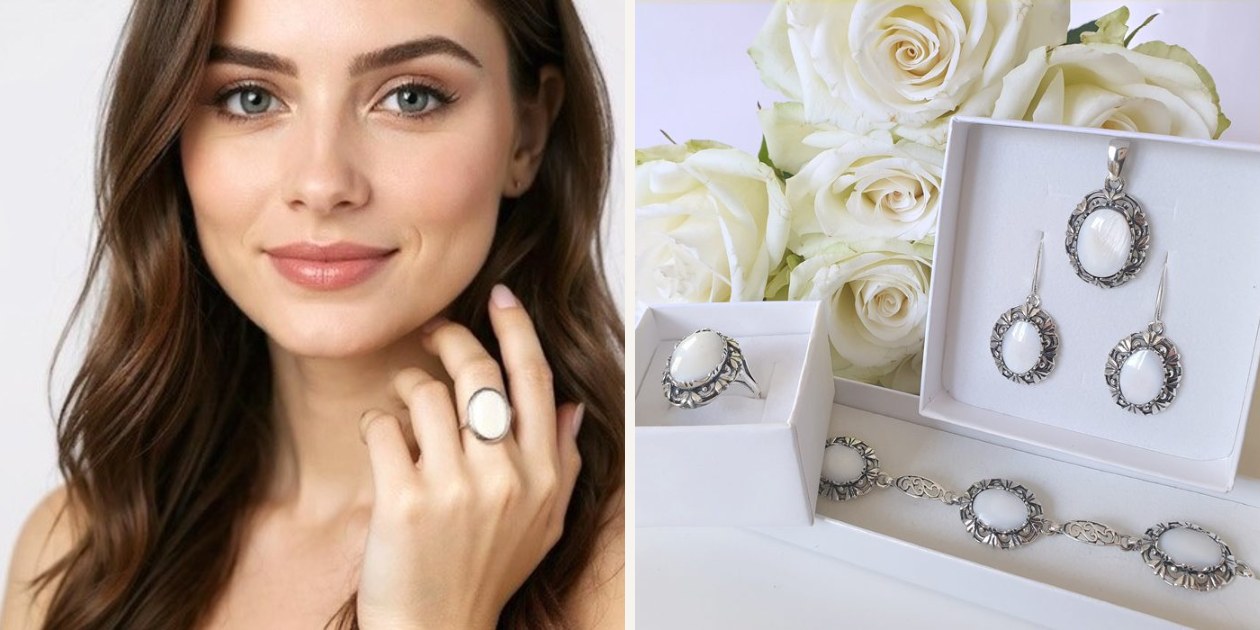
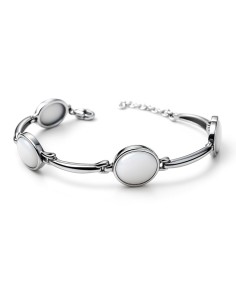
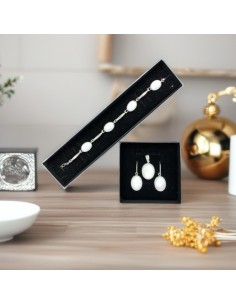
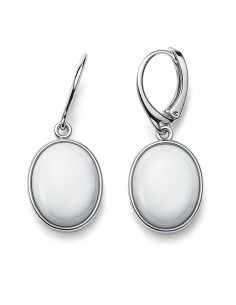
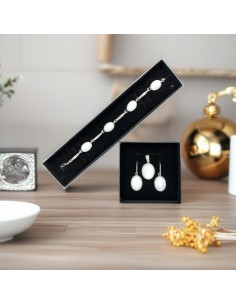
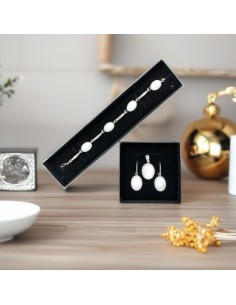
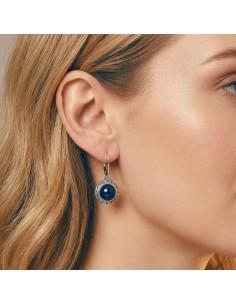
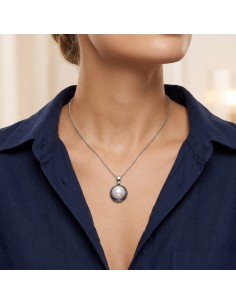
You’ll find mother of pearl in two of our series, among others. Series 2136 includes a ring, earrings, a pendant and a bracelet that easily come together as a set. Series 2160 includes a bracelet, earrings and a pendant. We’ve gathered all the designs in the mother of pearl in silver category, and more gemstone sets in our silver jewelry sets section.
Individual pieces may differ in small details, because each one goes through hand finishing. Our collection includes natural, reconstructed and synthetic stones, so we state the type of material in every product description — these designs included. You can read more about these terms in our article natural, synthetic or reconstructed stone. Our jewelry is tested by the Polish Assay Office — pieces over 5 g carry an official hallmark — and our maker’s mark is “DJ”.






Comments (0)