In short: the Mohs scale is a ten-step scale of relative hardness that ranks minerals by which one scratches which — from talc (1) to diamond (10). It tells you about scratch resistance, but not about resistance to knocks and breakage. For a ring you wear every day, choose stones rated about 7 and above, such as agate, onyx or cubic zirconia. Soft stones like amber, pearls, coral and malachite are better suited to earrings and pendants.
Why does one stone still look new after years, while another loses its polish within a few months? Most often it comes down to hardness. Gemstones and ornamental stones vary enormously, and the simplest tool for comparing them is the Mohs hardness scale. We explain how to read it, why the number isn’t everything and how to wear jewelry with different stones so it stays beautiful for a long time.
What is the Mohs hardness scale?
The scale of mineral hardness was devised in 1812 by the German mineralogist Friedrich Mohs. Instead of using instruments, he compared the hardness of minerals in a simple way: by checking which one scratches which. A mineral that leaves a scratch on another is harder than it. On that basis he chose 10 reference minerals and arranged them from softest to hardest, on a scale from 1 to 10.
In mineralogy, hardness means resistance to scratching or abrasion of the surface. Any other mineral can be placed between the steps: if it scratches apatite (5) but is itself scratched by orthoclase (6), its Mohs hardness is about 5.5. That’s why hardness is often given as a range, such as 6.5–7.
| Level | Reference mineral | For comparison |
|---|
| 1 | talc | greasy to the touch, easily scratched by a fingernail |
| 2 | gypsum | a fingernail leaves a scratch on it |
| 3 | calcite | scratched by a copper coin, but not by a fingernail |
| 4 | fluorite | a steel knife scratches it easily |
| 5 | apatite | a knife scratches it with noticeable resistance |
| 6 | orthoclase | scratches glass; a knife no longer scratches it |
| 7 | quartz | scratches steel |
| 8 | topaz | scratches all minerals lower on the scale |
| 9 | corundum (e.g., ruby or sapphire) | scratches topaz |
| 10 | diamond | scratches all the others |
Mineral hardness
Mohs Scale — Cheat Sheet
1 · Talcsoftest — you can scratch it with a fingernail—
2 · Gypsuma fingernail scratches itamber, 925 silver
3 · Calcitea copper coin scratches itcoral, pearl, mother-of-pearl
4 · Fluoritea steel knife scratches itmalachite approx. 3.5–4
5 · Apatitea knife scratches it (with effort)turquoise, lapis lazuli
6 · Orthoclasescratches window glasslabradorite, opal
7 · Quartzscratches glass and steelamethyst, agate, onyx
8 · Topazharder than quartzcubic zirconia approx. 8–8.5
9 · Corundumruby and sapphireruby, sapphire
10 · Diamondthe hardest mineraldiamond
Why isn’t the Mohs scale linear?
This 10-step scale is ordinal: it tells you which mineral is harder, but not by how much. The gaps between the steps are very uneven. Diamond (10) is many times harder than corundum (9), and the difference between them is far greater than between talc and gypsum.
Precise hardness measurements are made in laboratories. The best-known method is the Vickers test: a pyramid-shaped indenter is pressed into the material and the size of the impression is measured. When choosing jewelry, the Mohs hardness scale is all you need — it’s the order that counts, not the exact figures.
A curiosity: kyanite has a hardness of about 4.5–5 or 6.5–7, depending on the direction within the crystal. In most jewelry stones such differences are small, which is why charts give a single number or a narrow range.
Hardness isn’t toughness — cleavage and brittleness
The most common mistake when choosing a stone is treating this number as a measure of overall durability. The scale answers the question “Will the stone scratch?” but not “Will it crack if I hit my hand on a door frame?” Minerals of the same hardness can behave quite differently, because other properties determine resistance to impact:
- Cleavage — the tendency to split along specific planes. Diamond, topaz and labradorite have distinct cleavage: a hard knock at an unlucky angle can split them.
- Brittleness — susceptibility to chips and cracks. Emerald rates 7.5–8, but it usually contains numerous inclusions and fissures, so it can be brittle.
- Toughness — resistance to breaking. Jadeite rates about 6.5–7, yet thanks to its dense, interlocking structure it is exceptionally tough.
Inclusions and the cut matter too. The sharp edges of a faceted cut chip more easily than a smooth, domed cabochon. So look not only at a stone’s place on the scale, but also at the type of stone, the cut and the setting.
Hardness thresholds: what scratches a stone in everyday wear
Jewelry rubs against all kinds of materials every day. A fingernail rates about 2.5, 925 sterling silver about 2.5–3, and a steel knife and window glass about 5.5. The biggest threat, though, is ordinary dust and sand — they contain quartz particles (7). That’s why minerals with a hardness below 7 gradually turn dull from countless tiny abrasions, for example when you dry your hands.
In practice, three thresholds are useful:
- About 7 and above — stones for every day. Agate, onyx, chalcedony, amethyst and cubic zirconia stand up well to wear, even on the hands; just watch out for hard knocks.
- About 5–6.5 — stones to wear in moderation. Labradorite, opal, turquoise and lapis lazuli are happiest in earrings and pendants, and on a finger they’re best for going out, not for cleaning the house.
- Below 5 — delicate stones. Amber, pearls, mother-of-pearl, coral and malachite scratch easily, so protect them from friction and put them on last, after cosmetics.
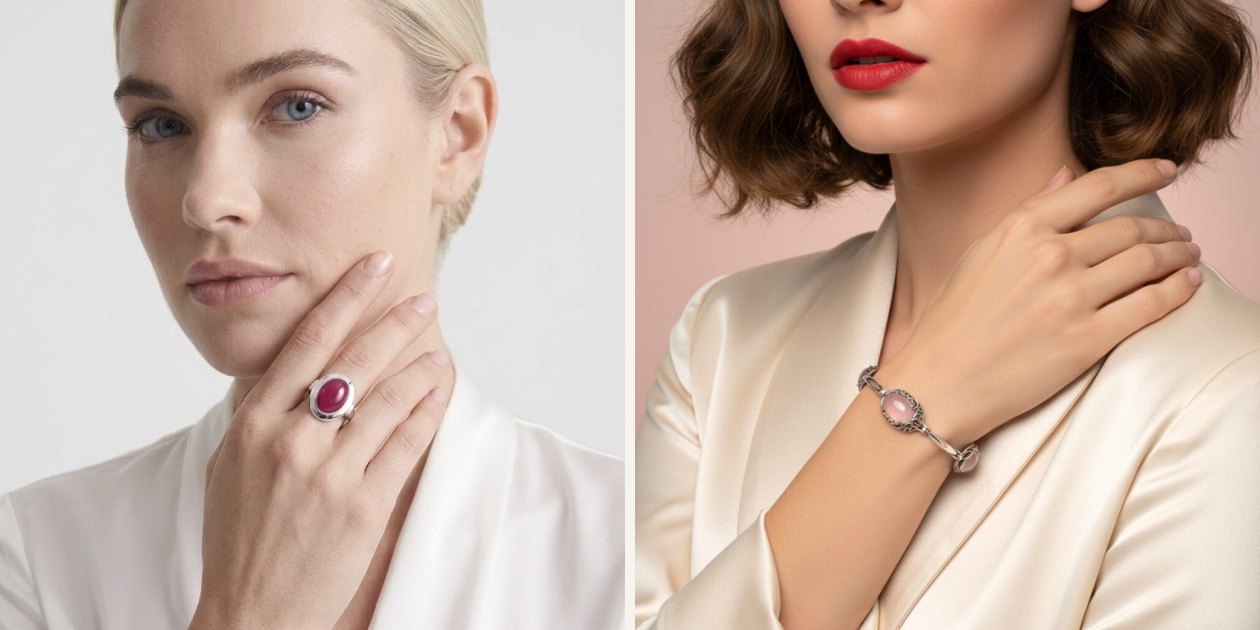
Mohs hardness of jewelry stones — chart and wearing tips
The values are approximate — mineralogical sources give them as ranges, because they depend on the variety and structure of the specimen.
| Stone | Hardness (Mohs) | How to wear it |
|---|
| Ruby, sapphire | 9 | Excellent for every day, including rings and bracelets. |
| Cubic zirconia | 8–8.5 | Handles daily wear well. |
| Topaz | 8 | Has cleavage — protect it from knocks. |
| Emerald | 7.5–8 | Brittle — wear with care and never clean it in an ultrasonic cleaner. |
| Rose quartz, amethyst, aventurine | about 7 | A good everyday choice; protect amethyst and rose quartz from long exposure to strong sun. |
| Agate, onyx, chalcedony | 6.5–7 | Very practical — they work in any kind of jewelry. |
| Labradorite | 6–6.5 | For everyday wear in moderation — it has distinct cleavage, so avoid knocks. |
| Opal (including synthetic) | 5.5–6.5 | Best in earrings and pendants; protect it from knocks, heat and chemicals. |
| Turquoise | 5–6 | Porous — take it off for handwashing, moisturizer and perfume; treat reconstructed turquoise the same way. |
| Lapis lazuli | 5–5.5 | Earrings and pendants; in rings, mostly for special occasions. |
| Malachite | 3.5–4 | Delicate and sensitive to acids — best in earrings and pendants. |
| Coral | 3–4 | Sensitive to sweat, perfume and acids — put it on after cosmetics. |
| Pearl, mother-of-pearl | 2.5–4.5 | Put it on last, wipe with a soft cloth, store separately. |
| Amber | 2–2.5 | Very soft — protect it from friction, alcohol and perfume. |
| 925 sterling silver (for comparison) | about 2.5–3 | Scratches easily; polishing restores the shine. |






Comments (0)